
 By
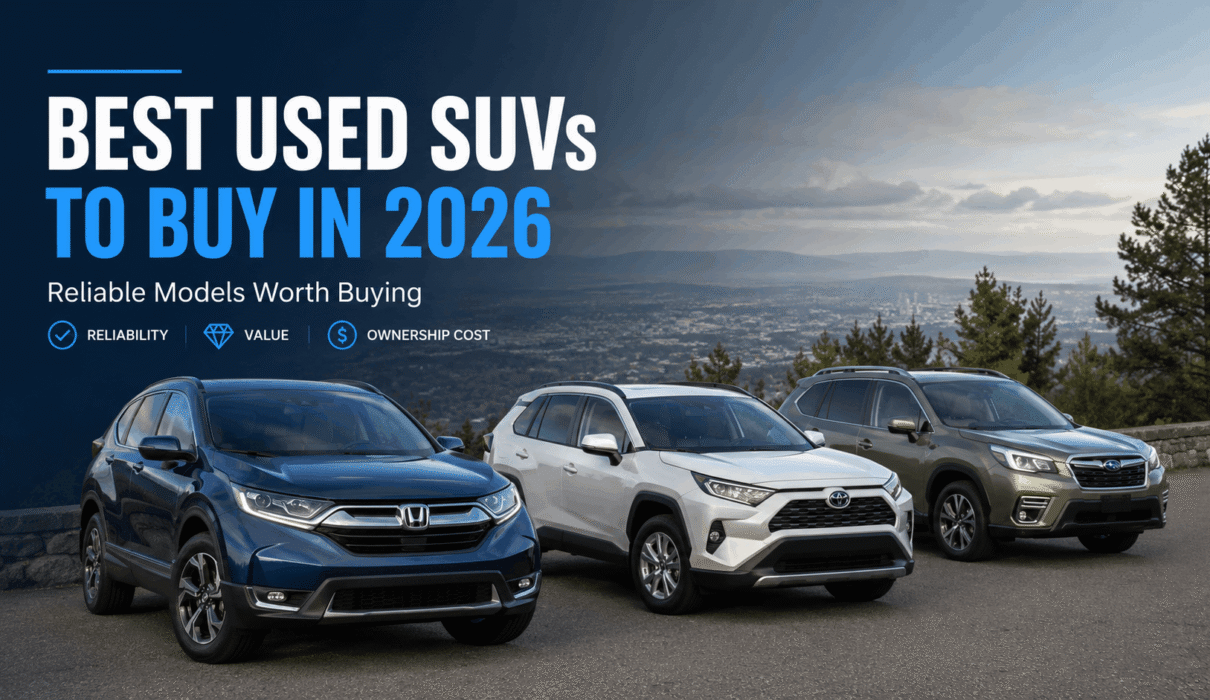
By The best used SUVs to buy right now are the Honda CR-V, Toyota RAV4, and Subaru Forester in the compact class, with the Toyota Highlander and Honda Pilot leading the three-row midsize segment. All five combine above-average predicted reliability scores, low repair costs relative to their class, and strong resale value the three factors that matter most once the new-car warranty runs out and you’re covering repairs yourself.
This guide ranks the strongest used-SUV picks by segment, walks through the reliability data behind each recommendation, and gives you a framework for judging any SUV you’re considering that isn’t on this list.
What Is the Best Used SUV to Buy?
Among mainstream compact SUVs, independent reliability comparisons place the Honda CR-V and Subaru Forester at the top of the class, with the Toyota RAV4 close behind. In head-to-head predicted-reliability scoring, the CR-V and Forester both land in the top tier, while the RAV4 especially freshly redesigned model years carries somewhat more uncertainty until more ownership data accumulates. Against the Subaru Outback, the CR-V and RAV4 both edge ahead on repair costs and segment ranking.
The practical takeaway: any of the CR-V, RAV4, or Forester is a defensible choice, and the right pick often comes down to specific model year, mileage, and price rather than a clear-cut winner across the board.
Best Used SUVs by Segment
| Segment | Top Picks | Why They Rank Highly |
|---|---|---|
| Compact SUV | Honda CR-V, Subaru Forester, Toyota RAV4 | Consistently top-tier predicted reliability and low repair costs within the segment. |
| Midsize 3-row SUV | Toyota Highlander / Grand Highlander, Honda Pilot | Above-average reliability scores for a segment that’s typically weaker on dependability. |
| Hybrid SUV | Toyota RAV4 Hybrid, Honda CR-V Hybrid | Two-motor hybrid systems with a strong reliability track record and real fuel-economy gains. |
| Off-road capable | Toyota 4Runner, Lexus GX | Body-on-frame construction with some of the highest reliability scores of any SUV segment. |
| Value / sub-$20K | Subaru Crosstrek, Nissan Rogue, Hyundai Tucson | Above-segment-average reliability at a lower entry price point. |
For a deeper comparison within each segment, see our companion guides on the Best Used Midsize SUVs, Best Used Compact SUVs, and Best Used Hybrid SUVs, plus our Best Used SUVs Under $20,000 guide if budget is the primary constraint.
Which Used SUV Is Most Reliable?
At the brand level, Lexus leads average SUV reliability scores by a wide margin, driven by consistent performance across its entire lineup rather than one standout model. Toyota follows, with a tight second tier made up of Nissan, Acura, Honda, Mazda, and Subaru. Within the volume compact-SUV segment specifically, the RAV4, CR-V, Nissan Rogue, Subaru Forester, and Hyundai Tucson all score well above the segment average meaning you’re unlikely to make a bad reliability decision cross-shopping any of these five on price and features alone.
The three-row midsize segment is where reliability tends to drop off industrywide, since added size, weight, and complexity introduce more failure points. Within that segment, the Toyota Grand Highlander and Highlander stand out as the strongest choices; the Kia Telluride and Hyundai Palisade are well regarded for features but land closer to average on long-term reliability, and the Volkswagen Atlas ranks among the weaker mainstream three-row options.
Which Used SUV Gives the Best Value?
Value isn’t just the lowest purchase price it’s the lowest total cost per mile of reliable ownership. On that basis, the Honda CR-V and Toyota RAV4 tend to combine the strongest resale value with the lowest average repair costs in the compact segment, which keeps both the buy-in and the ongoing ownership cost competitive. Subaru’s Forester and Crosstrek offer standard all-wheel drive at a lower price point, which is a meaningful value advantage in regions with snow or unpaved roads, even though Subaru’s average reliability scores trail Toyota and Honda slightly.
If your budget caps out below $20,000, our Best Used SUVs Under $20,000 guide covers realistic trims and mileage bands at that price, and our SUV Reliability Ratings guide explains the methodology behind how these scores are calculated in more detail.
Trim Levels and Complexity
As with sedans, trim level affects long-term reliability within a single SUV model. Higher trims often add adaptive suspension, panoramic sunroofs, larger touchscreens, and advanced driver-assistance features all of which are additional components that can eventually need service. A mid-tier trim without every available option typically represents the best balance between modern convenience features and long-term mechanical simplicity, particularly if you plan to keep the vehicle well past the factory warranty period.
What to Check Before Buying a Used SUV
- Confirm the specific trim and drivetrain AWD systems add complexity and repair cost versus FWD.
- Check for open recalls and technical service bulletins tied to the exact model year.
- For hybrid models, ask about hybrid battery health and any 12V battery replacement history.
- Review full service records, especially for CVT-equipped models where fluid changes matter.
- Get a pre-purchase inspection focused on suspension components, which see more wear in SUVs than sedans.
How We Evaluate These Picks
Rankings on this page draw on aggregated predicted-reliability scores, segment-level comparisons, and owner-reported repair-cost data across tens of thousands of individual vehicles. We prioritize brand-wide consistency over any single strong model, cross-check open recalls and known issues by model year, and weight midsize three-row SUVs against their segment average rather than against compact SUVs, since the two classes carry meaningfully different reliability baselines.
Compact vs. Midsize: Which SUV Segment Should You Buy?
Segment choice matters as much as model choice when it comes to long-term reliability. Compact SUVs like the CR-V, RAV4, and Forester carry simpler drivetrains, lighter curb weights, and in most cases a longer, more mature production history than three-row midsize SUVs, which tend to add complexity (more seating, bigger transmissions, additional electronics) without a proportional gain in ownership data. That’s part of why compact SUVs post stronger reliability scores as a category: it isn’t only about which brand builds them, it’s also that the segment itself is mechanically simpler.
If you need three-row seating, the data suggests narrowing your search to a handful of standouts the Toyota Highlander and Grand Highlander rather than assuming any three-row SUV will perform like a compact one. Some popular three-row options are strong on features and comfort but only average on long-term reliability, which is a reasonable trade-off for some buyers but worth going in with eyes open.
AWD, Hybrid, and Drivetrain Considerations
All-wheel drive adds mechanical complexity a transfer case, additional driveshafts, and (on some platforms) an extra electric motor which introduces more components that can eventually need service. That doesn’t mean AWD SUVs are unreliable; it means the base reliability of the platform matters even more once you add AWD, since a already-inconsistent drivetrain compounds the added complexity. This is one reason Subaru’s standard-AWD Forester and Crosstrek remain popular despite trailing Toyota and Honda slightly in average reliability scores: the value of standard AWD in snow or rural regions can outweigh a modest gap in dependability data.
Hybrid SUVs deserve a similar caveat. The RAV4 Hybrid and CR-V Hybrid both draw on two-motor hybrid systems with a strong reliability track record, largely because Toyota and Honda have been refining this hybrid architecture for well over a decade. Newer hybrid systems from other manufacturers, or first-generation hybrid variants of a traditionally gas-only nameplate, carry more uncertainty simply because there’s less long-term ownership data to draw on yet.
Common Mistakes SUV Buyers Make
- Buying based on cargo space and features alone without checking the specific trim’s reliability data.
- Assuming all-wheel drive is one system repair cost and complexity vary significantly by manufacturer.
- Skipping a suspension inspection, which sees more wear in SUVs than in sedans due to added ride height and weight.
- Overlooking timing-belt or timing-chain service intervals on older SUVs, which can be an expensive miss if skipped.
- Not checking whether a hybrid SUV’s battery is still within its manufacturer warranty window.
Buying at the End of a Lease vs. Traditional Used
A meaningful share of the used-SUV market comes from off-lease vehicles, typically two to four years old with documented maintenance under a manufacturer’s original warranty. These can be a strong middle ground between new and traditionally used: newer safety technology, likely still under part of the factory powertrain warranty, and a maintenance history that’s easier to verify through the manufacturer than a decade-old private-party sale. The trade-off is price off-lease SUVs sit closer to new-car pricing than an older used vehicle, so the value proposition depends on how much you’d otherwise spend on a new model with comparable equipment.
If you’re specifically shopping an off-lease RAV4 or CR-V, it’s worth checking whether any factory recalls tied to early production years of the current generation have already been completed dealers typically handle this before resale, but it’s a quick, free confirmation worth making regardless.
How This Fits Into Your Broader Search
Use this pillar page as your entry point into our full SUV coverage. Our SUV Reliability Ratings guide explains the scoring methodology behind these rankings in more depth, and our Best SUV to Buy for Reliability guide builds a defensible, methodology-driven shortlist rather than a generic list of names. If you’re specifically comparing the RAV4 and CR-V, our Toyota RAV4 Reliability and Honda CR-V Reliability pages go deeper on model-year-specific data for each.
Frequently Asked Questions
What is the best used SUV to buy?
The Honda CR-V, Toyota RAV4, and Subaru Forester are the strongest all-around picks in the compact class; the Toyota Highlander and Honda Pilot lead the three-row midsize segment.
Which used SUV is most reliable?
At the brand level, Lexus and Toyota post the strongest average SUV reliability scores. Among mainstream compact SUVs, the CR-V, RAV4, Nissan Rogue, Forester, and Hyundai Tucson all score well above their segment average.
Which used SUV gives the best value?
The CR-V and RAV4 typically combine the strongest resale value with the lowest average repair costs in the compact segment, making them the strongest value picks once total ownership cost is factored in.