 By
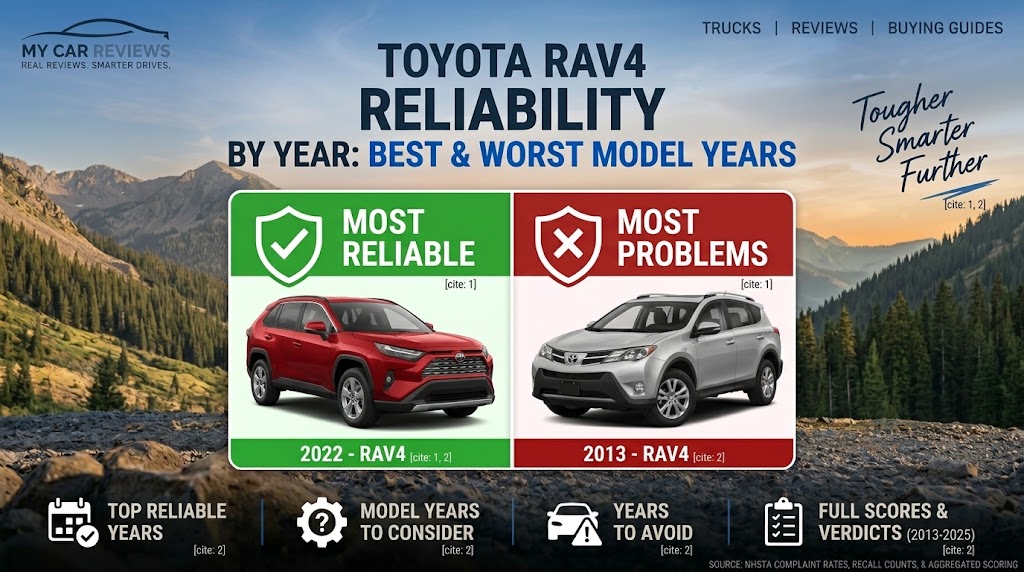
By The most reliable Toyota RAV4 model years are 2022, 2023, 2016, and 2024, each scoring 80 out of 100 or better in aggregated reliability tracking. The year with the most problems is 2019, which scores 66 out of 100, driven largely by fuel-propulsion complaints tied to the redesigned 8-speed transmission and early hybrid software calibration. Below is a full year-by-year breakdown with a quick buy, consider, or avoid verdict for every model year from 2013 through 2025.
Reliability data below draws on NHTSA complaint rates, recall counts, and aggregated scoring services, cross-referenced against Consumer Reports’ owner-survey data where available. Complaint counts reflect total volume reported to date, so newer years naturally show fewer complaints simply because they’ve been on the road for less time.
Toyota RAV4 Reliability Score by Year
| Year | Generation | Score | Verdict |
|---|---|---|---|
| 2013 | Gen 4 | 85/100 | Buy: first Gen 4 year, but check AWD coupling and sunroof drains |
| 2014 | Gen 4 | Good | Consider: infotainment and washer-pump complaints reported |
| 2015 | Gen 4 | Good | Consider: sunroof leak window closes out this year |
| 2016 | Gen 4 | 85/100 | Buy: engine and transmission fully matured, hybrid introduced |
| 2017 | Gen 4 | Good | Buy: consistent with 2016, low recall count |
| 2018 | Gen 4 | Good | Buy: final Gen 4 year, 6-speed automatic well proven |
| 2019 | Gen 5 | 66/100 | Avoid: weakest tracked year; fuel-system and 8-speed transmission complaints |
| 2020 | Gen 5 | 70/100 | Consider: improved over 2019 but still below the RAV4’s average |
| 2021 | Gen 5 | 73/100 | Consider: RAV4 Prime’s first year; watch for early hybrid cable concerns |
| 2022 | Gen 5 | 80/100 | Buy: strong rebound year, well above average |
| 2023 | Gen 5 | 80/100 | Buy: excellent reliability, low complaint rate |
| 2024 | Gen 5 | 80/100 | Buy: excellent reliability, IIHS Top Safety Pick |
| 2025 | Gen 5 | Best tracked | Buy: currently the strongest year in the lineup |
Which RAV4 Years Are Most Reliable?
2022, 2023, and 2024 each score 80 out of 100, making the current Gen 5 lineup’s recent production years the safest bet if reliability is the top priority. Within the older Gen 4 generation, 2016 stands out at the same 85-point level as 2013, edging ahead on crash-test rating even though both share the same underlying reliability score. Toyota’s most recent model, 2025, currently posts the best score of any year in the lineup, though it has the least accumulated ownership data simply because it’s the newest.
The common thread across every top-scoring year is a settled, unchanged powertrain. 2016 to 2018 represents Gen 4 at its most mature, after the 2013 to 2015 window’s early sunroof and transmission quirks had already been identified and addressed. Similarly, 2022 to 2024 represents Gen 5 well after the 2019 redesign’s initial problems were resolved.
Which RAV4 Years Have the Most Problems?
2019 is the clear outlier, scoring 66 out of 100 and standing out as the worst-reviewed year in the RAV4’s recent history. The redesigned 8-speed automatic transmission introduced with the Gen 5 launch drew a wave of complaints about rough or hesitant shifting, and the fuel propulsion system was the single largest complaint category that year. 2020 improved somewhat to 70 out of 100 but still trails the RAV4’s long-term average, suggesting some of the 2019 redesign’s issues carried over before being fully resolved.
Within Gen 4, 2013 and 2014 carry the highest risk of the AWD coupling failure that’s become one of the more widely discussed RAV4 issues, typically surfacing between 80,000 and 150,000 miles. 2013 through 2015 models are also the years most associated with sunroof drain-tube clogs that can lead to water intrusion and headliner mold if left unaddressed.
RAV4 Reliability by Generation
- Gen 4 (2013 to 2018): Best years are 2016 to 2018, once the AWD coupling and sunroof drainage issues identified in 2013 to 2015 were addressed. The 6-speed automatic paired with this generation has a strong long-term durability record.
- Gen 5 (2019 to present): 2019 is the clear weak point, tied to the redesigned 8-speed transmission and early software calibration. 2022 onward represents this generation at its most refined, with 2025 currently the strongest year tracked.
- RAV4 Prime (2021 to present): The plug-in hybrid’s first year, 2021, carries some early high-voltage cable concerns that were largely resolved in subsequent production.
Why Reliability Scores Improve Mid-Generation
A pattern shows up across both RAV4 generations: the first one or two model years after a redesign score noticeably lower than the years that follow, before settling into a stronger run toward the end of the generation. This isn’t unique to Toyota; it reflects how a new platform, engine, or transmission needs real-world mileage to surface issues that internal testing doesn’t always catch. Toyota’s response in both cases followed a similar pattern: address the issues through running production changes and software updates rather than a formal recall, which is part of why the complaint data shows a steady improvement across 2013 to 2018 and again across 2019 to 2024 rather than a single fix resolving everything at once.
For buyers, this pattern is a useful rule of thumb beyond just the RAV4: when shopping a specific generation of almost any vehicle, the middle-to-late model years typically carry less risk than the first year or two, simply because more of the platform’s early issues have already been identified and addressed by the time those later years reach production.
What to Check by Year Before Buying
- 2013 to 2015: Ask about AWD coupling service history and check the sunroof drain tubes for clogs or signs of past water intrusion.
- 2016 to 2018: Fewer specific concerns; verify routine maintenance and transmission fluid service history.
- 2019 to 2020: Confirm whether any transmission-related software updates were performed, and test the transmission thoroughly for shift quality during a test drive.
- 2021 (RAV4 Prime): Ask about high-voltage cable inspections or any related service bulletins.
- 2022 and newer: Fewer known issues; focus on standard pre-purchase inspection steps rather than year-specific concerns.
How Recall Counts Compare by Year
Recall counts add another useful data point alongside complaint scores, though the two don’t always move together. The 2020 model year carries 11 recalls, the highest of any recent RAV4 year, while 2018, 2022, 2023, and 2024 each carry a much lower count in the range of three to six. A higher recall count isn’t automatically a red flag, since it can reflect Toyota proactively addressing an issue before it becomes widespread, but it’s worth confirming that any recall work relevant to a specific used RAV4 has actually been completed. A dealer can run the VIN through Toyota’s system in a few minutes to confirm outstanding recall work at no cost.
It’s also worth separating safety recalls from the kind of owner-reported complaints that feed into reliability scores. A model year can carry several recalls addressing a narrow, easily fixed issue, such as a mislabeled capacity sticker, while still posting a strong overall reliability score. The 2018 model year is a good example: it has a low recall count and a strong reliability score, with its only mechanical recall involving the 12-volt battery bracket rather than anything related to the engine or transmission.
RAV4 Hybrid Reliability by Year
The RAV4 Hybrid has been part of the lineup since the 2016 model year, and its reliability trajectory largely mirrors the gas-only RAV4’s, since both share the same underlying platform and most of the same components outside the hybrid powertrain. Early hybrid years (2016 to 2018) benefit from the same mature Gen 4 platform that makes those years strong picks overall. The RAV4 Prime, introduced for 2021 as a plug-in hybrid, is the one exception worth flagging separately: its first year carries some documented high-voltage cable concerns that were largely addressed in later production, making a 2022 or newer RAV4 Prime the safer choice if reliability is the priority within that specific trim.
How This Fits Into Your Broader Search
This page expands on the year-by-year detail behind our Toyota RAV4 Reliability pillar guide. If you’re deciding between the RAV4 and other compact SUVs, our Best Used SUVs pillar compares it against the CR-V, Forester, and other top picks.
Frequently Asked Questions
Which RAV4 years are most reliable?
2022, 2023, and 2024 each score 80 out of 100 in aggregated reliability tracking, with 2025 currently posting the strongest score of any year. Within the older Gen 4 generation, 2016 through 2018 represents the platform at its most mature.
Which RAV4 years have the most problems?
2019 is the weakest tracked year, scoring 66 out of 100, driven mainly by fuel-propulsion and transmission complaints tied to that year’s redesign. 2013 to 2015 models carry a higher risk of the AWD coupling and sunroof drain issues associated with early Gen 4 production.
Sources
Auto Reliability Index: Toyota RAV4 Reliability by Year; CoverageX: Toyota RAV4 Problems by Year; TopSpeed: Ranking the Toyota RAV4 Model Years for Reliability; VinItel: Toyota RAV4 NHTSA Complaint Statistics; Consumer Reports: Toyota RAV4 Reliability by Model Year.